
As early as 1904, Australian Rules Football was part of community life in the local area. The neighbouring towns would play against each other in what appears to be an informal competition. The teams were often handicapped by the absence of players through injury and/or their farming commitments. Games between Torquay and Jan Juc (now Bellbrae) were often played in Torquay. Anglesea and Freshwater Creek also supplied teams and sometimes Germantown. To ensure a full complement of men on occasions towns combined to enjoy their friendly games of football. M. Hunter, F. Baensch and Brown were often named best players for Torquay. In the following years, Austin, Parker, and Smith showed prowess on the field. Connewarre had joined the competition in 1907 with their first game in many years played against Marshalltown. The game took place in Scott’s paddock, which appeared to be level, but the rough surface often caused the ball to turn unexpectedly. They were unable to sustain a team and folded until 1910, when they again assembled a team during the season for friendly games when other teams had a bye. An opportunity provided itself soon after the invitation to play a combined Torquay and Jan Juc at Torquay. With Germantown not having a game that weekend, they travelled to Torquay, and their players were distributed among both teams. The Geelong Advertiser (3/8/1910) reported the games as fast, vigorous and friendly. However, that didn’t seem to stop the hard knocks dished out by both sides.
In 1911, during the Geelong & District Football Association’s first annual general meeting, President James Galbraith offered to provide a trophy to encourage and improve football in the surrounding country districts, to promote competition among the Connewarre, Freshwater Creek, Jan Juc, and Torquay clubs. This gesture encouraged the secretary of the Jan Juc Football Club to write to the other teams and organise a meeting with the South Barwon Shire and Geelong Football Association. Unfortunately, none of the district delegates showed up, annoying the Geelong delegates. The Freshwater Creek Football Association was formed, with Grovedale and Modewarre joining the competition some years later.
At the Torquay Football Club presentation night in 1920, the captain, P. Tuck, presented medals donated by Basil Drayton to A. Duffield and Con Grossman for Most Improved. A special gold medal was presented to Powell Baensch for the best and most consistent man. That year the Torquay Football Club were runners up in the competition.
The competition during 1921 was not without controversy when the Connewarre club claimed the match between them and Torquay should be declared a draw, not a one-point win to Torquay. The central umpire had failed to report the match results to the Association by the required date, despite receiving reminders to do so. Additionally, there was conflicting evidence from the timekeeper and goal umpires regarding scoring cards. The outcome was that the game was declared null and void and a rematch ordered. Torquay went on to become Runners Up that year.

Formed after WW1 with the colours of blue and white. The Torquay Football Club competed in the newly formed Freshwater Creek Football Association in 1921. The four competing teams were Freshwater Creek, Modewarre, Connewarre and Torquay. Some games were played at Grovedale.
The first season was not without controversy, with a game between Torquay and Connewarre being declared ‘null and void’ after some irregularities by the umpire and inconsistencies between the timekeeper and goal umpires. Reinforced by the Torquay goal umpire not producing his scorecard before the enquiry. By 1924 it was Belmont, Barrabool, Grovedale, Barwon Heads, Freshwater Creek and Moriac in the race for the premiership.
Like many other activities, the club ceased to exist during World War II.
The club regrouped in March 1952 at a meeting attended by 40 people. George McCartney who called the meeting was appointed President. Vice presidents were N. Tomkins and H. (?) Thomas, secretary, H.V. Davies; and treasurer, Mr Wills. Other committee members included Jarvis (senior), Timms, Elsley, Parker, Daniels, Dodd, and Aldridge.
Viv Berryman, who passed away in 2008 at the age of 96, was the last surviving coach from that period. The Richmond Football Club donated second-hand jumpers, and hence the club became known as the Torquay Tigers.
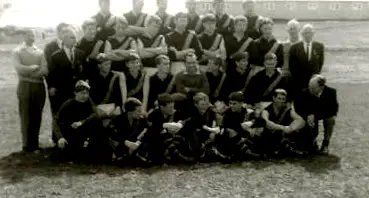
The first under-15s team was formed in 1952 and played in yellow windcheaters with a Superman motif on the front. This team trained on a reserve at the end of Gilbert Street and was coached by George McCartney

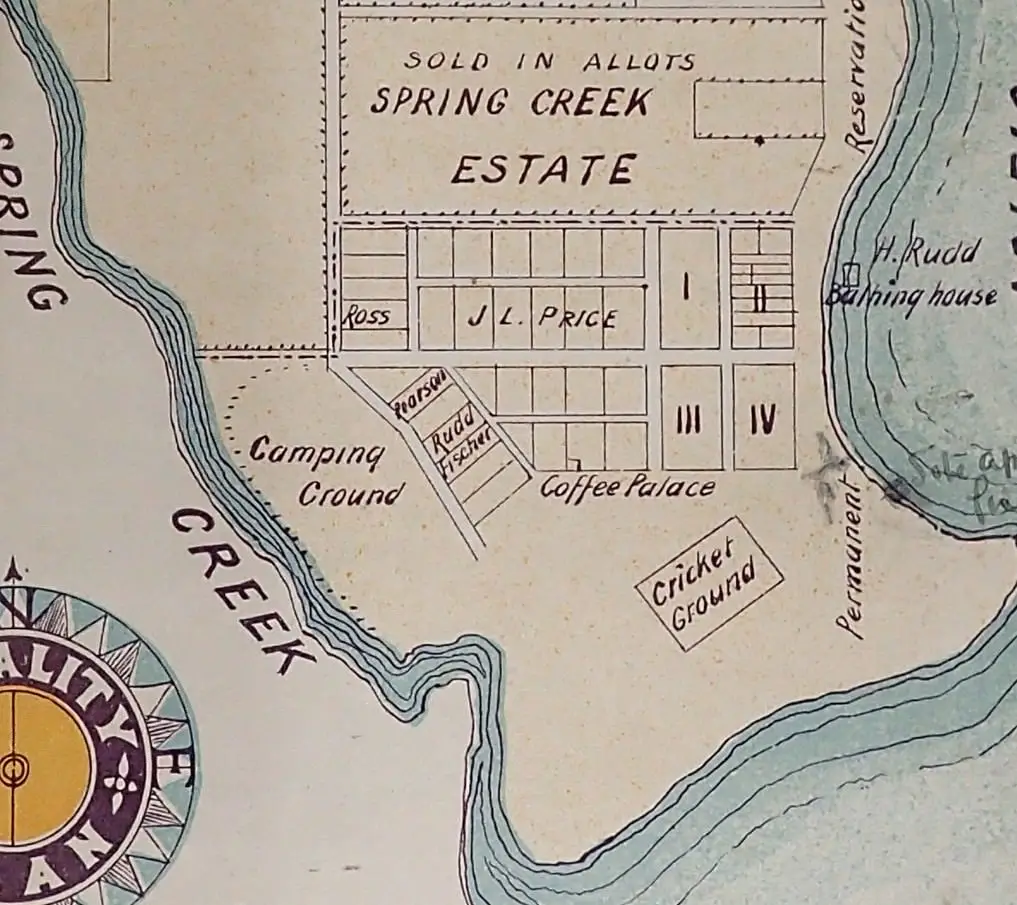
Early competitions were played on the oval which is now the camping ground with teams changing at the hotel across the road. While the clubrooms were built in 1959, games were played at Spittle’s paddock (near McDonald’s) with players changing at the wine shop (now a fruit shop).
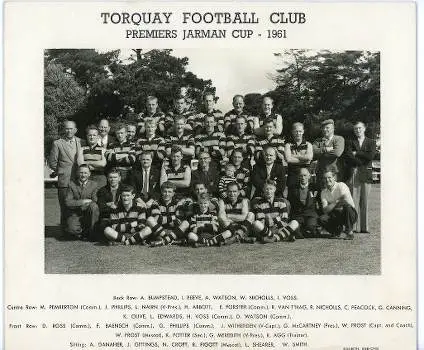
Initially teams played in the Geelong and District League, winning their first flag in 1961 in the Jarman Cup Competition. The club transitioned to the Polwarth League for a brief period before joining the newly formed Bellarine Football League in 1971, with both the Seniors and Reserves
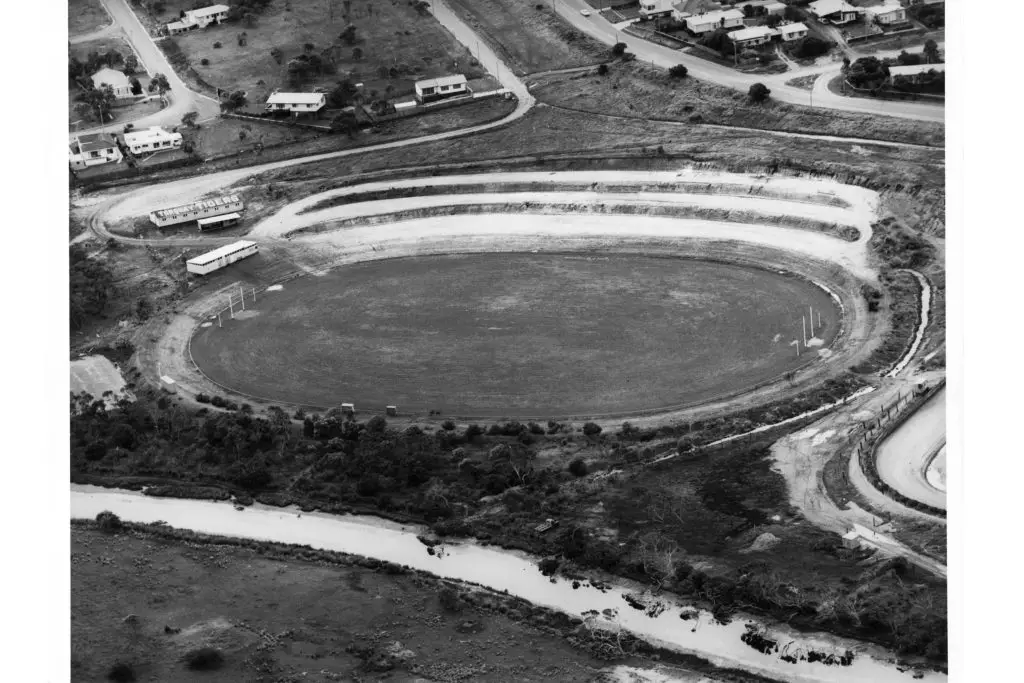
George McCartney, Laurie Nairn, Lester Edwards, and others pushed for an oval, and in the late 1970s, a new complex, under the control of the City of South Barwon, was built on the oval site. Others involved in the club’s development were Fraser Stewart, Brian Scott and Andy Bumpstead. In 1984 flood lighting was installed.
The Club has grown considerably, especially in recent times, and now fields sides in the Bellarine Football League, the Geelong Junior Football League, and the YMCA competition, as well as the very important introductory Auskick football program.
SOURCE: